(01) Why It Matters
The Ground Has Moved Under Every Market
Every business already runs on a system, whether anyone designed one or not. The real question is whether it was built on purpose, or whether it assembled itself over a decade, one tool at a time, each one bought to solve a problem that had already become urgent. Most of the small and mid-sized businesses I work with are running the second kind, and it quietly sets the ceiling on how fast they can grow.
This matters more now than it did three years ago, because the ground under every market has shifted. It is not only what a business sells that has changed. It is how buyers arrive, what they already know when they get there, and how little patience they have for the gap between asking and being answered.
Search engines now answer questions directly instead of handing over ten links. AI assistants compare vendors, summarize reviews, and produce a shortlist before a person visits a single website. By the time someone reaches out, they have often done most of their evaluating somewhere a business cannot see, and they arrive later in the process, better informed, and expecting a faster answer than they would have expected in 2023.
Read that figure carefully, because the obvious conclusion is the wrong one. Adoption is not the advantage. A tool that everyone has stops being a differentiator the moment it becomes standard. The advantage sits with the businesses whose operations can absorb the change: where an enquiry generated by an AI answer lands somewhere specific, gets answered within the hour, gets quoted the same day, and gets followed up without anyone having to remember to.
That capability is not a piece of software. It is a system, and it has to be designed.
The businesses that will find 2027 and 2028 difficult are not the ones that skipped an AI tool. They are the ones whose operations were never built to absorb a change in how work arrives, so when the channel shifts, every part of the operation has to be rebuilt by hand at once.
of organizations now report regular AI use in at least one business function, up from 78% a year earlier. Source: McKinsey, The State of AI, 2025.
Extension Cords Are a System Too
Picture a workshop that grew without a plan. It started with one bench and one outlet. A second machine arrived, so someone ran an extension cord. Then a third, plugged into the second cord. Then a fourth. Every machine works perfectly on its own. Nobody thinks about the wiring at all, right up until the day two machines run at once and the breaker trips.
The wiring was always a system. It was just never designed. Nobody made a decision about it, so a decision got made by accident, and the cost of that accident only appears when the load increases.
Most businesses are wired exactly this way. A website that emails enquiries into somebody's inbox. A spreadsheet where quotes are tracked, mostly. An accounting package that someone re-keys numbers into at month end. A CRM that was purchased two years ago and that nobody has opened since the third week. Each of these tools does its own job competently. The failures are not happening inside any of them.

The losses happen at the seams. A lead that sat in an inbox for two days. A quote that was never chased because the person who sent it was on a job site. A completed project where nobody asked for a referral, because nobody outside the delivery team knew it had closed. None of these appear on a profit and loss statement as a line item. All of them show up as a business working flat out and growing slowly, where the owner is convinced the answer is more leads, when the leads already arriving are leaking out between the tools.
Wire It in Stages. Nobody Wires a Whole Building at Once.
The word "system" makes most owners think of a two-year project and a number they do not want to hear. That is not how this gets built, and a business that tries to wire everything at once mostly buys its own assumptions in software form.
It gets built in stages, and each stage is complete and useful on its own.
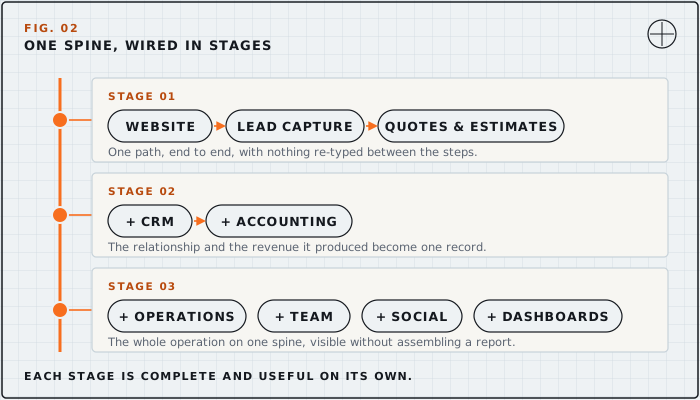
Stage one is the narrowest version that still does real work: the website, lead capture, and quoting connected into one path with nothing re-typed between them. Every enquiry lands in the same place. Every quote is issued from that same place. The status of both is visible without asking anyone. For a one-person business or a team of three, this stage alone often removes several hours a week and stops the leak that costs the most.
Stage two connects the relationship to the money. A CRM joined to the accounting system means the history of a client and the revenue that came from that client are finally the same record. Which client is worth what, which service actually earns, and which relationship has gone quiet all become answerable questions rather than opinions.
Stage three makes it the centre of the business. Website, social, sales, operations, delivery, the team's own workflow, accounting, and reporting all running on one spine, with dashboards that show the state of the business without anybody assembling a report.
The reason to build in stages is not cost. It is that each stage has to be lived in before the next one can be designed properly. What you learn running stage one for three months is what makes stage two fit the business instead of a software vendor's idea of it.
What the Investment Actually Buys
There is a real cost to this, and it deserves stating plainly. What it buys deserves the same.
It buys control, in the literal sense: the ability to see the state of the business without asking three people and waiting a day. It buys capacity, because the next thirty percent of volume no longer automatically requires the next hire. It buys speed, which in most markets is now the whole competitive difference, since the business that answers first and quotes same-day wins work it would otherwise have lost on merit. And it buys durability. When a channel changes, and channels are changing faster than at any point in the twenty-nine years I have been doing this, you reconnect one part of the system rather than rebuilding how the entire business operates.

Those four returns are not separate benefits. They feed each other. Connected work produces clean data as a by-product rather than as a chore. Clean data makes decisions faster and less argumentative. Faster decisions free capacity that was being spent on coordination. That freed capacity gets reinvested into the system, which connects more of the work. Run this loop for two years and the gap between a business with a designed system and one without becomes very hard to close, which is why when you start matters more than how big you start.
Where to Start
Not with software. Buying a platform before mapping the work is how businesses end up with three tools that overlap and a team that has quietly gone back to the spreadsheet.
It starts with a map of how the business actually runs today, seams included. This is the work we do inside Solution Architecture & Design: mapping the real workflow, auditing where it breaks, and designing the spine before anyone chooses a single platform.
Four questions worth answering first, because the answers usually locate the first stage on their own:
- Where does an enquiry actually land, and how long can it sit there before anyone would notice?
- What gets typed twice in a normal week, by whom, and into what?
- Which question about the business can nobody answer without opening three tools and doing arithmetic?
- What would break first if volume doubled next quarter?
In twenty-nine years I have never met an owner who actually wanted more software. What they wanted was to stop carrying the whole operation in their head, and to take two weeks off without the business wobbling while they were gone. That is what a designed system really buys, and it is worth considerably more than the tools it runs on.
Javad AhmadiBrand Transformation Architect
The businesses that come through the next few years in good shape will not be the ones that adopted the most tools. They will be the ones that decided, deliberately, how their business should run, and then built something that runs it that way. That decision is available at any size, to a one-person operation as much as to a team of fifty, and it is considerably cheaper to make now than it will be to make under pressure later.
Topics
- AI Marketing
- CRM & Automation
- Customer Experience
- Digital Marketing
- Lead Generation
- Marketing Systems