
(01) Why It Matters
Comprehensive Branding, Marketing, Advertising and Creative Support for More Than a Decade
Gallery Specialty is a Canadian door hardware manufacturer based in the Toronto area, with manufacturing and sourcing reaching well beyond it. For more than a decade we have worked as their branding, marketing, advertising and creative partner.
The role changed early on. Supporting isolated projects became managing the ongoing brand, product, marketing, digital and sales work as a whole, which is a different job with a different standard attached to it.
Gallery operates in a technical, product-intensive industry. Hundreds of products, each with its own specifications, finishes, technical drawings, pricing and application requirements, all of which have to stay accurate and consistent everywhere they appear. At the same time their sales team needs sophisticated presentations produced against deadlines that leave no room for a process.
So the challenge was never creative execution on its own. It is holding technical accuracy, brand consistency, speed, product knowledge and presentation quality together at once, across disciplines that are usually kept apart.
Product Catalogue Management.
The catalogue is the largest single responsibility, running to roughly 380 pages. We manage the whole of it: the product photography, the design and layout, the specifications, the technical information and drawings, the way products are organized and presented, and the additions, revisions and pricing updates that arrive continuously.
The website functions as an online extension of that catalogue, which means both have to agree. A product detail that is right in print and wrong on the site is not a small inconsistency in this industry. It is a wrong order, a returned shipment and a distributor who checks everything twice from then on.
Product Launches and Communications.
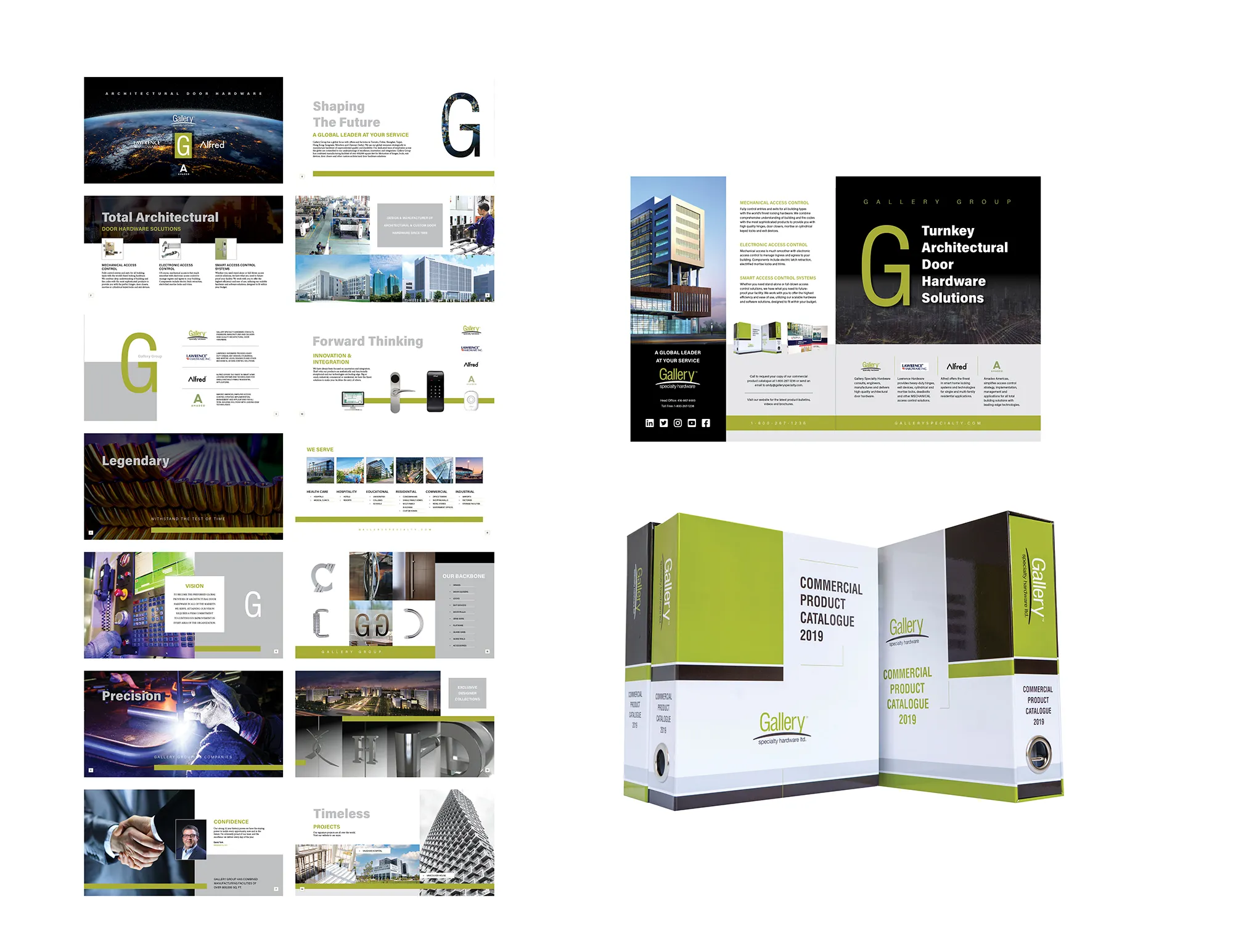
Gallery introduces and updates products constantly, and each one needs the communications that bring it to market: product bulletins, feature campaigns, brochures, product sheets, digital content, website updates and material built for specific verticals.
The point is not to present a product. It is to make its value legible to the architect, builder, designer or distributor who has to decide whether it belongs in their project.
Sales Presentations in 48 Hours.
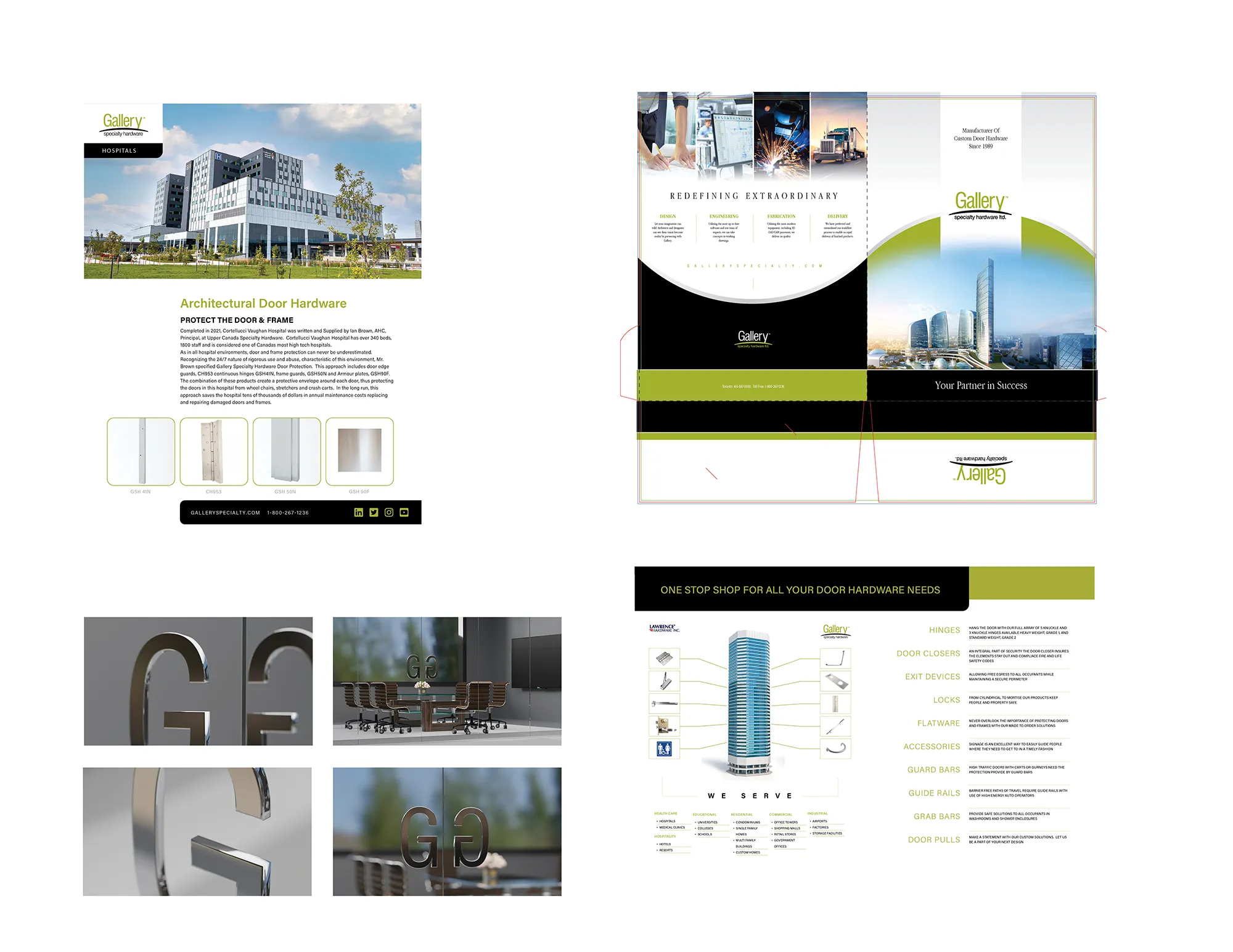
This is the part of the relationship that gets tested hardest. For a major opportunity, Gallery may hand us little more than architectural information, a door reference, a set of product selections, finishes, hardware requirements or preliminary drawings.
From that we build a finished presentation showing how those specific locks, levers, handles, finishes, doors and hardware work together in the actual residential or commercial environment being proposed. Work that would ordinarily involve several specialists and weeks of coordination is sometimes needed inside 24 to 48 hours.
It gets done because the capability sits in one place. Gallery moves on the opportunity while their sales team stays focused on winning it.
One Team Instead of Eight Suppliers.
Handled the traditional way, this work would require Gallery to coordinate a brand strategist, a graphic designer, a photographer, a copywriter, a web developer, a marketing specialist and a production designer, then keep all of them aligned.
We are not a large agency, and that is the point. The disciplines sit together in a small team that already knows the products, so strategy, photography, design, digital, catalogue production, product communications and sales presentations move at the same time rather than in a queue. Coordination stops being Gallery's job.
That is the argument behind the Brand-to-Revenue Performance System. Most companies buy marketing in fragments, each supplier competent, none accountable for the whole, and the brand pays for the seams. Gallery's catalogue, website, product communications and sales presentations all read from one strategy, which is why 380 pages and a 48-hour presentation can carry the same standard.
Speed That Comes From Knowing the Business.
Responding quickly is not a service level. It is the compound result of years spent inside Gallery's products, technical requirements, brand standards and processes.
That distinction matters, because it sets what happens when a deadline compresses. The timeline moves. The standard does not.
What It Frees Gallery to Do.
Gallery does not rebuild a team every time a catalogue, a launch, a presentation, a website update, a photograph or an opportunity appears. One partner is already holding the brand, the products, the technical requirements and the business in mind.
What that buys is not a discount on creative work. It is the ability to put more of their own people on product development, sales and market growth, while the marketing and creative infrastructure keeps running behind them.
A decade in, the relationship is not a collection of projects that happened to repeat. It is the reason Gallery can move quickly without deciding, every time, who is going to do the work.