(01) Why It Matters
Building a Category for a New Kind of Stone Cladding
Stone Lamina makes an engineered cladding system: real stone veneer bonded to a composite honeycomb panel, lighter, stronger and more versatile than conventional dimensional stone, for exterior and interior work across commercial, residential, institutional, renovation and retrofit projects.
They came to us needing collateral. What they actually needed was for a category to exist.
Being first is not an advantage on its own. It means there is no shelf to sit on, no comparison the buyer already understands, and no precedent to point at when a decision has to be defended.
Why Architects Hesitate to Specify Something New.
Architectural specification is conservative by design, and correctly so. A specifier who names a material is attached to that decision for the life of the building. The safe choice is the material that has been on facades for a century. The new one carries every unasked question: does it burn, does it delaminate, does it hold in a storm, will anyone stand behind it in twenty years.
Stone Lamina had answers to all of it. Non-combustible construction, a flame spread index of zero, a Class A rating, an epoxy bond engineered for extreme wind and temperature loads, four attachment methods, LEED contribution and a lifetime warranty. Alongside those, the commercial advantages: rapid fabrication, a high strength-to-weight ratio, sound dampening, impact resistance, and materially lower transport and installation cost.
What they did not have was a way to put those answers in front of a specifier in the order a specifier needs them. A buyer cannot want a thing they have no name for, and cannot approve a thing they cannot compare.
Positioning Before Collateral.
This is worth naming, because it happens often. The request was for Execution work: a catalogue, a brochure, a website. The problem sat one level up, in Foundation.
The Brand-to-Revenue Performance System exists to be entered where the pain is loudest, and clients are usually right about where it hurts and wrong about what is causing it. Producing beautiful collateral for a product nobody has a category for would have been expensive and useless. Settling what the product is, who it is against and how it should be compared had to come first, and then the catalogue had something to be built on.
A Catalogue Built Around Comparison.
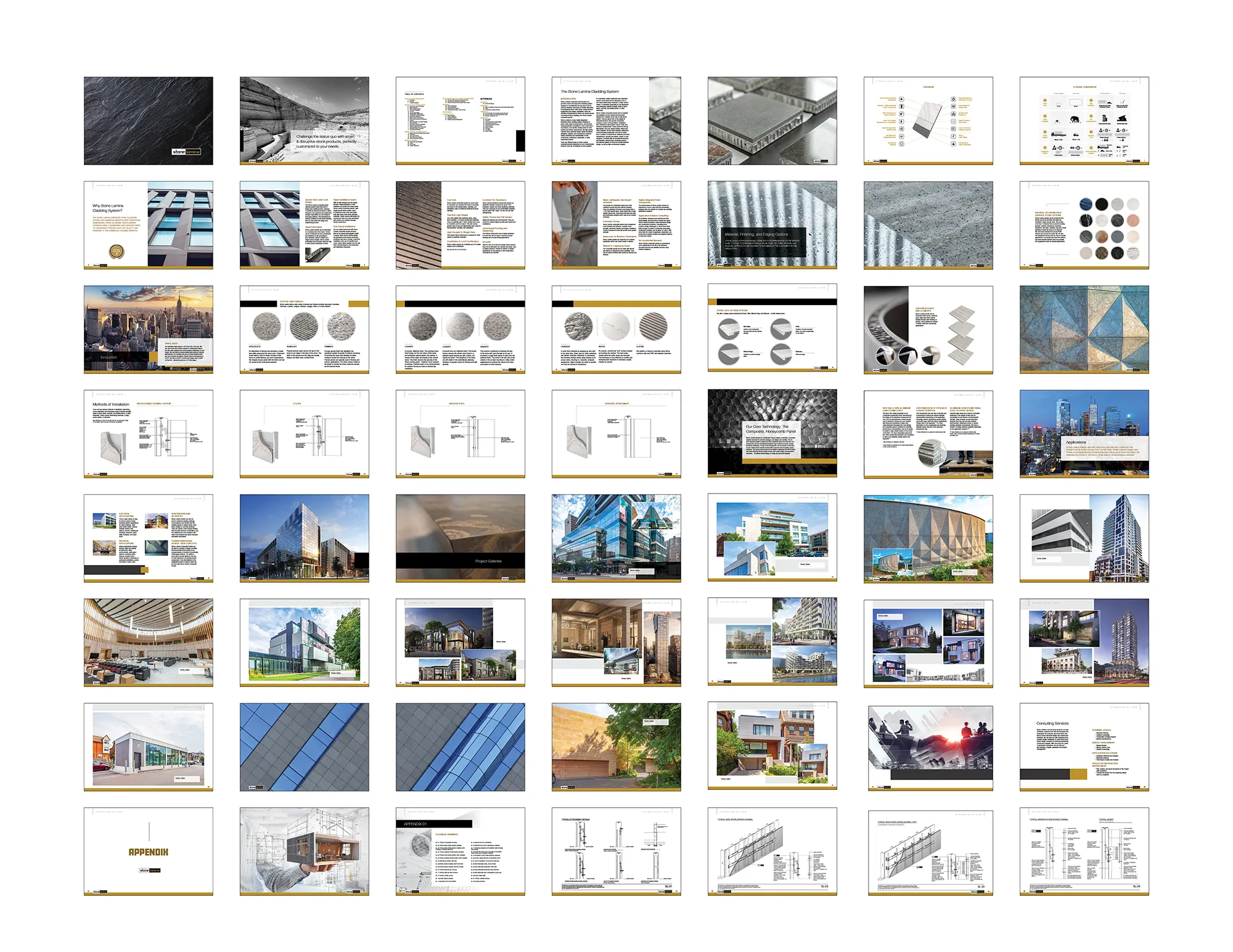
The catalogue became the primary instrument, and it was not a layout exercise.
It had to carry the cladding system itself, the benefits, the installation methods, the panel technology, the applications, project galleries, consulting services and technical drawings, and hold all of that in an order that a professional reader could descend through at their own speed. Deep enough to satisfy the engineer who has to defend the choice. Direct enough not to lose the architect who is still deciding whether to care.
The organizing decision was comparison. The material leads with what a specifier already knows, conventional stone cladding, and places the panel directly against it on the measures that decide a project: weight, strength, fire performance, installation speed, transport cost, design freedom. That framing does work no adjective can, because it lets someone evaluate an unfamiliar product using judgment they already trust.
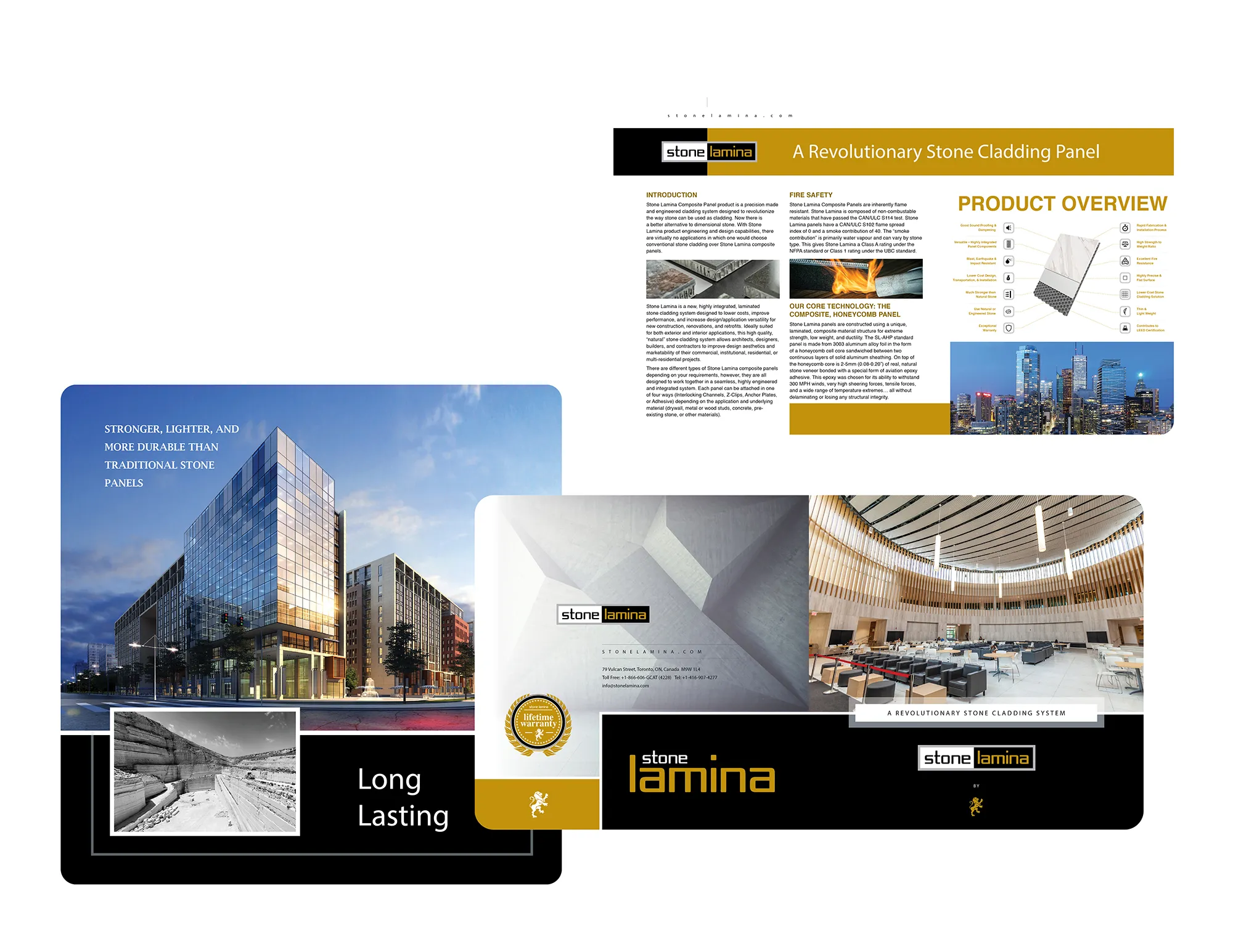
Brand, Website and Collateral.
Around the catalogue we built the identity and visual presentation, the company marketing brochure, the website, and the sales and marketing collateral for both online and offline use, all reading from the same position so the product met an architect the same way in every format.
Photography, Video and 3D Visualization.
A composite panel is difficult to believe in a photograph, because the entire claim is that it looks like solid stone and does not behave like it. We produced project photography, video and 3D visualization to hold both truths at once: the finished surface that reads as natural stone, and the section that shows why it weighs what it does.
For this product the visuals are not support material. A buyer has to understand the engineering and the architectural possibility in the same moment, and only one of those can be explained in words.
Why They Chose Us.
Plenty of studios can lay out a catalogue. Fewer can read a manufacturing, construction or architectural product closely enough to work out what its story actually is, then build the whole sales and marketing system around that answer.
That combination, manufacturing fluency alongside catalogue development, technical communication, photography, video, visualization and brand positioning, is what let Stone Lamina present itself as a company that had thought the problem through rather than a supplier with a new product to move.
An innovation nobody can specify is an expensive hobby. The work was to turn a better product into a defensible choice.