(01) Why It Matters
The Walk-In Clinic and the Surgeon
A business owner can now produce a four thousand word article in thirty seconds, a brochure over lunch, and a month of social posts before the coffee goes cold. Every one of those outputs is real, and most of them are worth less than the time they saved. That gap, between what these tools can produce and what they can decide, is where a lot of small and mid-sized businesses are quietly hurting themselves right now.
I want to be careful here, because the argument is not that the tools are bad. They are extraordinary, and we use them daily. The argument is about which job you are handing to them.
You wake up with a headache and a fever. You go to the walk-in clinic, you take something for it, the pain lifts, and by evening you have forgotten about it. That is a quick fix used exactly right: a small, self-limiting problem, treated cheaply, with no need to understand it any further.
Now picture a knee that has been getting worse for six months. You can take the same painkiller. It will work. The pain will lift and you will walk on that knee again, and that is precisely the problem. The painkiller did not treat anything. It removed the signal that was telling you to stop, and you spend another three months grinding down a joint that needed imaging, a specialist, and an actual diagnosis half a year ago.

That second case is where a great many businesses now sit with AI, and it is worth being precise about which part is the mistake. The mistake is not reaching for the painkiller. The mistake is not knowing which of the two situations you are in. Nobody books a surgeon for a headache, and nobody should be treating a structural problem in their business with something that was only ever designed to make the symptom quieter.
less low quality, unoriginal content now appears in Google's search results following its March 2024 core update, a larger reduction than the 40% Google had expected. Source: Google Search Central.
Speed Was Never the Bottleneck
Sit with the four thousand words in thirty seconds for a moment, and ask a simple question: what was actually slow before?
It was not the typing. For almost no business was typing ever the constraint. The constraint was knowing what to say, who it was for, and why any of it would matter to them. That is a judgment problem, and these tools have not solved it. What they have done is remove the friction that used to force you to confront it.
Writing four thousand words used to take two days, and somewhere inside those two days you were made to notice that you did not really know what you were arguing, or who you were arguing it to. The slowness was doing a job. It was a diagnostic, and it was free. Now the output arrives before the thinking does, and nothing in the process stops to tell you the thinking never happened.
This is why so much AI-assisted marketing feels simultaneously competent and empty. Nothing is wrong with it. There is simply nothing in it that could only have come from you.
The Machine Gives Everyone the Same Answer
There is a second problem, and it is structural rather than a matter of effort.
These models are trained on what already exists, and what they return is the centre of it. Ask one to describe a business like yours and you get a genuinely competent description of the average business like yours. Ask it for your differentiators and it will produce the differentiators that businesses in your category typically claim, which is to say the ones your competitors are also claiming.
Think of it as a map drawn entirely from footprints. It shows, accurately and usefully, where everyone has already walked. Ask it for a route and it sends you down the busiest path, because the busiest path is what the map is made of. That is exactly what you want when you need to reach a well-known destination quickly. It is useless when the whole objective is to end up standing somewhere nobody else is standing.
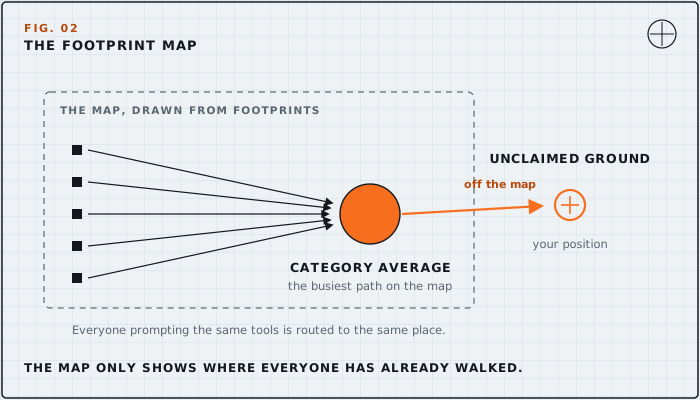
Positioning is the business of standing where nobody else is. Marketing produced by averaging the market is structurally incapable of getting you there. It is not a matter of better prompting. You are asking a tool built to find the middle to deliver you an edge.
The distribution side is moving in the same direction. The systems that decide who gets seen are actively filtering for exactly this.
Producing undifferentiated content has become close to free at the same moment that distributing it has become considerably harder. Those two curves are moving apart, and volume is on the losing side of the gap.
What the Quick Fix Actually Costs
The reason this trap is so easy to fall into is that the bill does not arrive for a while. You publish the content. Nothing breaks. The brochure looks fine. The website goes live. In the short term the quick fix appears to have simply worked, which is the most persuasive argument imaginable for doing it again.
The costs show up later, and they show up in three places.
The first is sameness. When you and four competitors all describe yourselves in the language the same tools produce, a prospect comparing you has nothing to compare except price. You have not saved money on marketing. You have moved yourself into a price fight, which is far more expensive than the marketing was.
The second is trust. People are getting quicker at recognizing copy that nobody stood behind. It reads as fluent and slightly hollow, and the impression it leaves is not that you are efficient. It is that you did not think the reader was worth the effort, which is a strange first impression to pay for.
The third is the one from the knee. Because the symptom went quiet, you never found out what was actually wrong. The business that generated a year of content to fix a lead problem still has whatever caused the lead problem, and has now spent a year not looking at it.
Use It as an Accelerator, Not as a Driver
None of this is an argument for doing things slowly on principle. It is an argument about sequence.
Work runs in four stages: diagnose the actual problem, decide what you are going to do about it, produce the work, and distribute it. AI is genuinely excellent at the last two, and it is not qualified to touch the first two, because it has no access to your market, your margins, your clients, or what you are actually trying to become. The quick fix is the dashed line on the diagram below: the jump straight from "we need content" to "produce", skipping the only two stages where the value was.
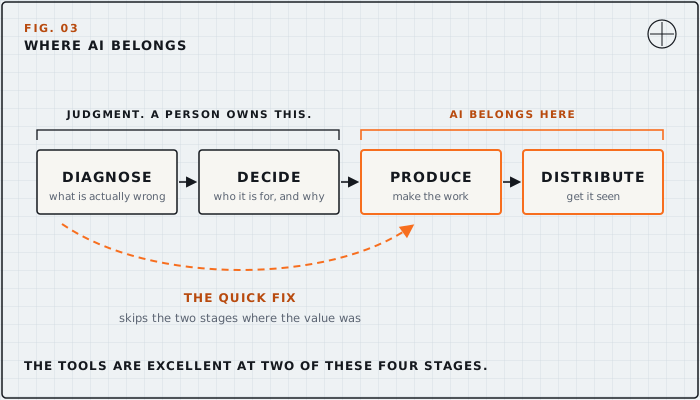
Used in the right two stages, these tools are transformative, and we lean on them hard. That is precisely how we run AI-Generated Production: multiple engines accelerate the production itself, while art direction, colour science, brand alignment and quality control stay with people who are accountable for the result. The technology compresses the work. It does not choose what the work should be.
Before you next reach for a tool to solve something, four questions are worth answering first:
- Is this a headache or a knee? A social post for Thursday is a headache. What your business stands for is not.
- If a competitor prompted the same tool with the same brief, how different would their output be from yours?
- What decision am I skipping by generating this instead of thinking about it?
- Who is accountable for this being right, as opposed to being finished?
I am not against these tools. I use them every single day and they are remarkable. What concerns me is watching an owner hand over the one part of the job that was genuinely theirs, the decision about who they serve and what they stand for, to a machine that has no way of knowing either. In twenty-nine years I have never seen speed be the thing that was holding a good business back.
Javad AhmadiBrand Transformation Architect
The businesses that come through this period in good shape will not be the ones that refused the tools, and they will not be the ones that handed everything over to them either. They will be the ones that did the unglamorous part first: sitting down, naming what is actually wrong, deciding what they intend to be known for, and only then turning the accelerator on. The tools will still be there when the thinking is finished. The opening to be genuinely different from everyone else prompting the same machine will not stay open nearly as long.
Topics
- AI Marketing
- Business Growth
- Content Marketing
- Marketing ROI
- Marketing Strategy