(01) Why It Matters
Nobody Is Building the House
A designer in one place, a copywriter in another, an agency running the ads, a family friend handling social, and someone internal holding it all together in the margins of their real job. Every one of them competent, every invoice defensible, and the marketing still does not work. In twenty-nine years this is the most common condition I see in small and mid-sized businesses, and almost nobody recognizes it as a condition at all.
They think they have a performance problem. What they have is a structural one.
Picture building a house by hiring the framer, the electrician, the plumber and the roofer separately, with no architect and no general contractor. Each trade is skilled and does precisely what you asked for.
The framer does not know the electrician needs a chase through that wall. The plumber arrives after the slab has cured. The roofer finishes before anyone confirms where the vents go. Nobody has done bad work and the house does not function. Call everyone back and each trade can prove, correctly, that the fault was not theirs.
This is what owners find hardest to accept, because it does not match how failure normally works. There is no bad actor to remove. Firing the designer and hiring a better one changes nothing: the problem was never inside any of the boxes. It lives in the space between them, and nobody was hired to stand there.
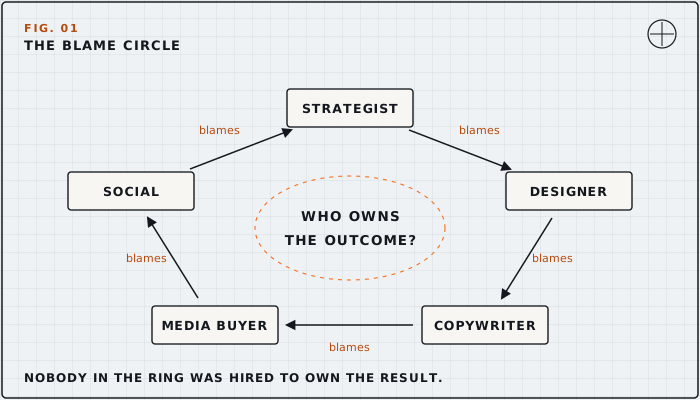
Sit in on the meeting after a quarter that underperformed and you will hear the same conversation every time. The strategist says the creative did not follow the strategy. The designer says the copy came in late and off brief. The copywriter says nobody ever gave them the positioning. The media buyer says the creative did not convert. Every person in that room is telling the truth about their own piece of it, and not one of them was ever accountable for the result.
of martech stack capabilities are actually used by marketers, down from 42% the year before, with overlapping solutions among the top barriers cited. Source: Gartner Marketing Technology Survey.
The Savings Are Real. The Bill Is Somewhere Else.
Businesses do not arrive here through carelessness. They arrive through a series of individually sensible decisions.
A family friend does good design and gives you a rate. Someone recommends an agency for ads. An overseas supplier will build the site for a fraction of the local quote. Each choice is defensible on its own, and the saving on each is genuine. That is the trap. The savings are real, they are visible, and they arrive on an invoice with a number you can point to.
The costs are equally real and they arrive nowhere. There is no line item for the campaign that ran three weeks late because two suppliers were waiting on each other, or the brochure redone because the designer never saw the positioning document, or the ad that contradicted the website in front of the exact customers you were trying to convince.
And there is no line item at all for the most expensive one: you can no longer tell what worked. When a quarter underperforms and five parties touched it, you have five candidate explanations and no way to test any of them. That is not a marketing operation. It is a series of unrelated experiments with no control, which means next quarter you will guess again.
The same pattern shows up in the software, and for the same reason.
Overlapping tools are what happens when several parties each buy what they need with nobody holding the whole. The tools are simply the version of this you can see on a statement.
Every Supplier You Add Is Not Just One More
There is a mechanism underneath this, and it explains why fragmented marketing gets worse faster than owners expect.
When you add a supplier, you do not add one thing to manage. You add a relationship with every supplier already there. Two suppliers have one relationship between them. Three have three. Five have ten. Seven have twenty-one.
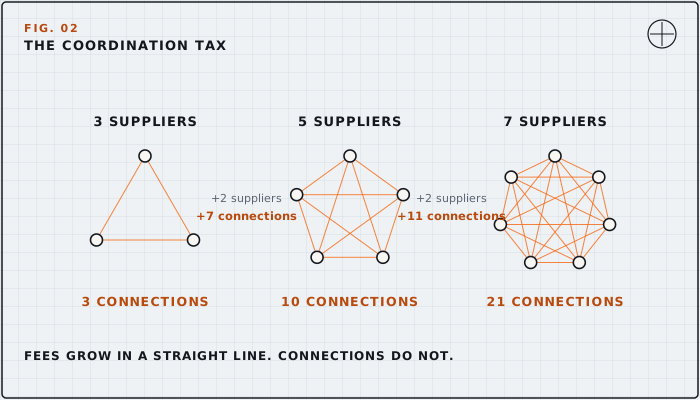
Your fees grow in a straight line. The connections between the people you are paying grow as a curve. Every one is a place where a brief can be misread, a deadline can slip unnoticed, a brand rule can be quietly broken, or the same work can be done twice by two people who did not know about each other.
This is why bringing in one more freelancer to close a gap so often makes the whole thing slower. You did not add a person. You added several new places for things to come apart.
You Became the Integration Layer
Here is the cost nobody prices, and it is usually the largest one.
All of those connections still have to be managed by somebody. In a small or mid-sized business that is almost always the owner, or one marketing manager hired to do something else entirely.
You are the one who actually knows the strategy, so you brief everyone. You notice the ad contradicts the website, because you are the only person who sees both. You chase the late file, explain the brand to the new freelancer for the fourth time, and reconcile two suppliers who quietly built different versions of the same thing.
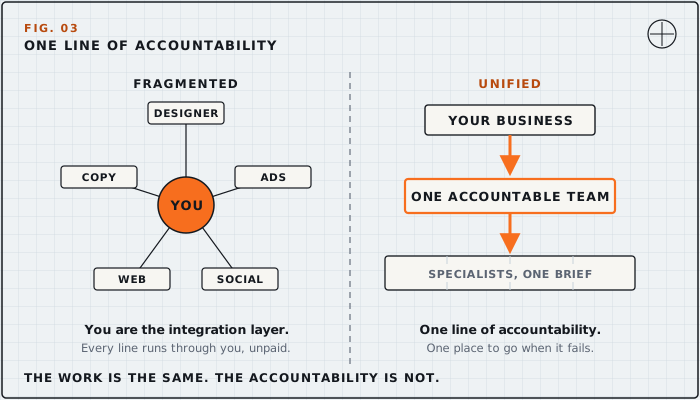
That work is real, it is skilled, and it appears on no invoice, which is precisely why it feels free. It is not. It is the most expensive labour in the building, done by the person whose attention the business needs most, in the hours they should have spent on what only they can do.
So the saving was never thirty percent. It was thirty percent, minus your own hours at whatever an hour of your attention is actually worth, minus the rework, minus the quarters that underperformed for reasons nobody could isolate.
This has intensified over the past two years. Owners now have tools that make it feel possible to carry more of the coordination themselves: draft the brief, check the designer's work, rewrite the copy that came back wrong. What those tools really did is raise the ceiling on how much fragmentation one person can absorb before it visibly breaks. The structure did not improve. The person holding it just started carrying more, for longer, before anyone noticed the strain.
What One Accountable Team Actually Changes
The argument for consolidating is not that one supplier is cheaper. Often it is not, on the invoice, and any firm that leads with that is selling on the wrong thing.
What changes is that somebody owns the outcome rather than a deliverable. When a quarter underperforms there is one place to go, and the diagnosis becomes possible at all, because the strategy, the creative, the campaigns and the measurement came from the same brief by people who talk to each other. You can finally tell what worked, which means you can do it again on purpose.
That is the entire argument behind our system: four connected domains operated by one team, drawing on one strategy and measured against one set of numbers, rather than four services bought separately and hoped into alignment.
Before you change anything, four questions are worth sitting with:
- When last quarter underperformed, who was accountable for the result, rather than for their own deliverable?
- How many hours a week do you personally spend briefing, chasing or reconciling suppliers, and what is an hour of your attention worth?
- Could each of your suppliers state your positioning in one sentence, and would those sentences match?
- When two of them disagree, who decides?
If the answer to the last one is "me", you already know what you are actually paying for.
I have sat in a lot of rooms where five suppliers each explained, entirely correctly, why the failure was not theirs. Every one was telling the truth, and the client had still lost a year they were never getting back. That is usually the moment an owner realizes they never bought marketing at all. They bought five deliverables and gave themselves the job of turning those into marketing.
Javad AhmadiBrand Transformation Architect
None of this is an argument that the people you hired are bad at their jobs. Most are good, and many are doing excellent work inside the narrow window they were given. It is an argument that competence in five separate places does not add up to a working marketing operation, any more than five skilled trades add up to a house. What decides the outcome is whether one party is accountable for the thing you actually wanted, which was never a logo, a campaign or a content calendar. It was growth you could see, explain, and repeat on purpose.
Topics
- Choosing an Agency
- Marketing Operations
- Marketing ROI
- Marketing Strategy
- Marketing Systems
- Small Business Marketing