(01) Why It Matters
Brand Is Not Your Logo. It's the Trust You've Earned.
Ask ten business owners what their brand is, and eight will describe a logo, a colour palette, a tagline. Ask what their positioning is, and most will point to the same tagline again. Both answers miss the point, and the confusion is expensive.
Brand and positioning are not decoration. They are two different jobs, doing two different kinds of work. Brand is the trust a business builds with the people it serves. Positioning is the discipline of sharpening focus, on what a business sells and who it sells it to, so that focus can go toward solving one problem well instead of many problems adequately.
Handled together, the two reinforce each other and growth compounds. Handled separately, or confused for one another, a business can work harder every year and still start from zero with every new customer. Consider two businesses selling the same service in the same city. One has invested in looking polished: a sharp logo, a slick website, a consistent colour palette everywhere. The other looks plainer, but every client who's worked with them refers three more. The plain one is winning, because what it built was trust, not a look. That's the distinction the rest of this piece rests on.
Let's separate the two, and then put them back together.
Every business already has a brand, whether anyone designed one or not. It isn't the visual identity. It's the sum of every promise made and every promise kept, or broken, across every interaction a customer has ever had with the business.
Think of brand as a ledger. Every time a business delivers exactly what it said it would, on time, at the standard promised, that's a deposit. Every time a customer gets a good experience they didn't expect, that's a deposit too. Every broken promise, every "we'll follow up" that never happens, every quality slip, is a withdrawal.
Most businesses never check the balance. They keep spending on advertising to bring in new customers while the trust ledger with the customers they already have quietly runs into deficit. New customers end up costing more to acquire than the business is retaining in trust from the ones it has, and growth stalls even as the business works harder than ever.
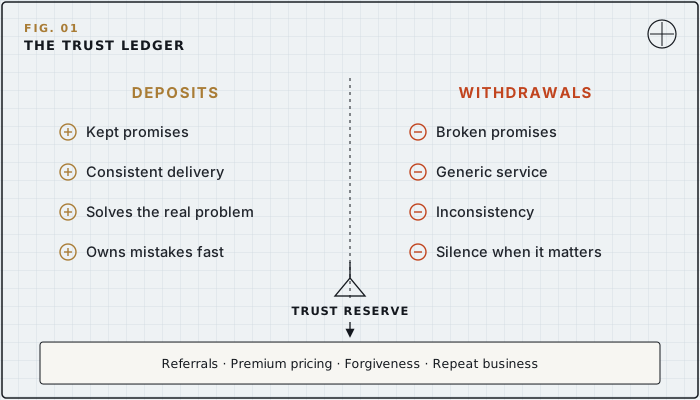
The businesses with strong brands have a healthy balance. Customers extend them credit: the benefit of the doubt when something goes wrong, patience during a rough patch, and, most importantly, they vouch for the business to other people without being asked. That's what a brand actually buys. Not attention. Reduced risk in the mind of the buyer.
That reduced risk shows up in practical terms long before anyone measures it as loyalty. It shows up as a shorter sales cycle, because a trusted business has fewer objections to answer. It shows up at renewal time, when a customer doesn't bother comparing three alternatives because switching feels riskier than staying. It shows up when a mistake happens and the customer's first assumption is that it will get fixed, rather than that they've been taken advantage of. None of that gets built by a single campaign. It gets built one kept promise at a time, which is why brand can't be outsourced to a project with a start and end date. It has to be lived operationally, every day, by everyone who touches the customer.
of consumers say trust is a deciding factor or a deal breaker in a purchase, and those who trust a brand are more than twice as likely to stay loyal. Source: Edelman Trust Barometer.
Positioning Is Not Your Tagline. It's the Discipline of Choosing.
If brand is about earning trust, positioning is about deciding whose trust is worth earning, and for what.
Picture two light sources putting out the exact same amount of energy. One is a floodlight. It spreads that energy across a wide area, and the result is a dim, even glow that lights up everything a little and nothing well. The other is a laser. The same energy, concentrated into a single narrow beam, cuts through steel.
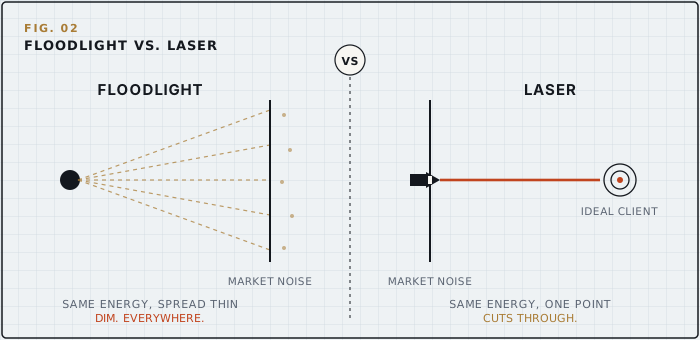
Most small and medium sized businesses run as floodlights. They describe themselves in language broad enough to apply to almost any customer with almost any problem, because saying no to potential business feels like leaving money on the table. The result is a business that's dimly visible to everyone and genuinely compelling to no one.
Positioning is the decision to become a laser: to choose a specific customer with a specific problem, and to organize the entire business, service, message, delivery, pricing, around solving that problem better than a generalist ever could. It isn't a smaller ambition. It's the same energy, aimed.
Picture two accounting firms in the same market. One advertises accounting services for businesses of all sizes, hoping to catch anyone searching nearby. The other says, plainly, that it works exclusively with construction contractors, and it speaks fluently about progress billing, retainage, and seasonal cash flow the way a specialist would. A contractor comparing the two doesn't experience this as a smaller offer. They experience it as the firm that already understands their business before the first meeting even starts. That's positioning doing its job: not narrowing opportunity, narrowing the aim so the shot actually lands.
This is uncomfortable, because positioning requires saying no. Every segment a business declines to chase is a segment it stops spending energy trying to impress. That discomfort is the point: the energy that used to be spread thin across everyone now goes toward becoming genuinely excellent for someone.
How Brand and Positioning Work Together
Treated separately, both ideas break down. Positioning without brand produces a sharp pitch nobody believes yet, a business that knows exactly who it's for but hasn't earned the trust required to be chosen. Brand without positioning produces trust that never compounds, goodwill spread across too many types of customers and problems to build a reputation specific enough to be remembered for anything.
The two form a loop, and the order matters.

Positioning comes first. It answers who the business is for and what specific problem it solves. That clarity determines where every dollar of trust-building effort should go. Brand follows. It's the repeated, visible proof, delivered to that specific audience, that the business does what it said it would do. Trust compounds, because the audience is focused rather than scattered, and each proof point reaches people who talk to each other and recognize the pattern. That compounding trust earns pricing power, referrals, and retention: the resources to go deeper into the same focus rather than chase a wider one.
Run the loop forward and it's easy to see why sharply positioned businesses seem to get luckier over time. The contractor-focused accounting firm's positioning tells the market exactly who to refer it to. Every project delivered on time and on budget becomes a proof point that lands with an audience primed to recognize it. One contractor's trusted advisor is another contractor's referral. Pricing power follows, because a named specialist doesn't get shopped against a generalist on rate. None of that trust would compound the same way if the firm were still trying to serve retail shops, dentists, and contractors all at once.
This is why treating brand and positioning as separate projects, a logo refresh here, an ad campaign there, rarely produces a different result. They are one system. Sharpen the focus first, then build the reputation around it, and the two start reinforcing each other instead of working against each other. Positioning tells the market who a business is for. Brand proves it was worth choosing. Most businesses invest heavily in one and then wonder why the other never shows up.
What It Costs to Skip This
The businesses that skip positioning are easy to recognize. Their marketing tries to speak to everyone, so it ends up sounding like everyone else's. Prospects can't tell them apart from three competitors in the same search results, so the conversation defaults to price. Every sale gets fought for individually, on a service that reads as interchangeable.
The businesses that skip brand are recognizable too. They generate leads but can't convert them without a long, expensive sales process, because nothing about the business has proven itself to the prospect yet. Referrals are rare, since there's no reputation clear enough to describe to someone else. Every customer relationship starts from zero, every time, regardless of how many customers came before.
Both problems eventually show up in the numbers, even when no one is tracking brand or positioning directly. Win rates on proposals drop when a business can't explain why it's different from the last three quotes a prospect collected. Customer acquisition cost climbs year over year while retention stays flat. The sales team starts asking for more collateral and more discounting to close the same volume of business. These are positioning and trust problems wearing a numbers disguise, and no amount of additional advertising spend fixes them, because the underlying issue was never visibility. It was focus, and proof.
If a stranger tried to describe what your business does, and who it's for, in one sentence, without you in the room, would the sentence they'd say match the one you'd want them to say?
And separately: if that same stranger asked your last five customers whether they'd recommend you, would the answer be an immediate yes, or a pause?
The gap between the answer a business wants and the one it would actually get is usually the exact size of the work still left to do.
Where This Starts
Neither problem gets solved with a new logo or a clever slogan. Positioning starts with an audit nobody enjoys: who is the business actually best at serving, and what specific problem does it solve better than a generalist would. Brand starts with an equally uncomfortable one: what has this business promised, explicitly or implicitly, and where has it actually delivered versus fallen short.
This is precisely the audit we run with clients inside our Brand Strategy & Positioning process: market and competitive analysis, value proposition development, audience mapping, and a positioning framework the whole team can work from.
A useful place to begin is with direct questions, answered about the business as it is rather than as you intend it to become:
- Positioning: If this business turned away every customer outside its ideal profile tomorrow, could it describe, in one sentence, who would be left and what problem unites them?
- Positioning: What does this business turn down today that it should be turning down on purpose instead of by accident?
- Brand: What has this business promised customers, in writing or in spirit, that it doesn't consistently deliver?
- Brand: Which five customers would vouch for this business unprompted, and has anyone ever actually asked them to?
The answers rarely require new information. They require someone willing to look at the business as it actually operates, not as it's described in its own marketing.
Most small and medium sized businesses don't need more marketing activity. They need a sharper answer to who they're for, and a track record specific enough to that answer that trust starts compounding instead of resetting with every new customer.
That's not a campaign. It's a foundation, and everything built on top of it works better once it's in place.
I've spent twenty-nine years watching businesses confuse being known with being trusted. They're not the same thing. Positioning earns you the introduction. Brand earns you the second conversation, and every one after that.
Javad AhmadiBrand Transformation Architect
If it's time to trade a message built to reach everyone for one that earns trust with the right people, start the conversation.
Topics
- Brand Strategy
- Brand Trust
- Business Growth
- Customer Experience
- Marketing ROI